Why Do Businesses Choose Stretch Robots for Packaging?
On a busy shipping floor, hand-wrapping pallets can produce uneven tension, loose film, and repetitive work for operators. A stretch robot applies film around pallet loads using programmed movement, helping teams make wrapping more consistent. That matters when cartons vary in height, shifts run long, or outbound orders move quickly. Some systems allow operators to adjust wrap patterns, turntable speed, and film tension for different loads. Small settings can make a visible difference.
Businesses also consider stretch robots when they want to improve throughput and reduce reliance on physically demanding wrapping tasks. A robot may help standardize how many film layers cover a load, but results depend on the pallet, film, machine settings, and maintenance. There is no magic here. A poorly configured system can still wrap loads badly, and unusual shapes may need careful testing. Before choosing equipment, teams should compare their daily pallet volume, available floor space, load stability, and integration needs. They should also ask suppliers about training, service, and safe operating procedures. These details are less exciting than speed claims, but they matter on an ordinary Tuesday.
For many facilities, the decision is not simply manual work versus automation. It is whether a stretch robot fits the real flow of goods, staff, and shipping deadlines. A practical evaluation can start with sample pallets and recorded wrapping times. The right choice should improve consistency without creating new bottlenecks. And sometimes, the honest answer is to wait.
What Stretch-Wrapping Robots Are and How They Work
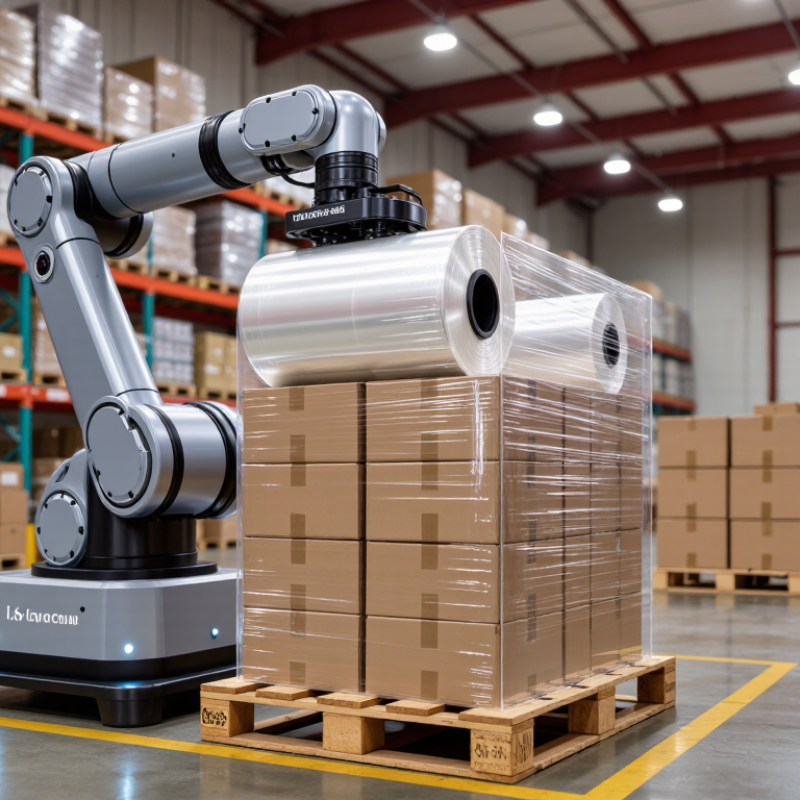
Stretch-wrapping robots secure pallet loads by winding stretch film around them. Depending on the system, a robot arm circles a stationary pallet, or a mobile unit travels around it. A powered film carriage controls tension and pre-stretch, while programmed settings determine wrap speed, overlap, and film layers. Sensors may help detect load height, but operators often still set or check the recipe.
The goal is a stable load, not simply a tight one.
Automation is spreading across industry. The International Federation of Robotics reported 4,281,585 industrial robots operating worldwide in 2023, in its World Robotics 2024 report. That figure covers all industrial robots, not stretch wrappers, so it shows broader adoption rather than wrapper performance. MHI’s 2024 Annual Industry Report found that 55% of surveyed supply-chain professionals planned to increase technology investment.
Useful context, not a promise of savings.
On a packaging floor, an operator positions a pallet, selects a wrap program, and checks the finished load. A robot can make film application more consistent across shifts and reduce repetitive walking. Not magic. Poor tension can crush cartons; too little can leave loose corners. Test real loads and track film use, stability, and changeover time. A slightly awkward reality: someone still needs to reload film, clear faults, and inspect pallets.
How Robots Integrate with Packaging Operations
Why Do Businesses Choose Stretch Robots for Packaging?
How Robots Integrate with Packaging Operations
Stretch-wrapping robots work best as part of the packaging flow, not as standalone machines. At a pallet station, a conveyor delivers a load, a sensor confirms its position, and the robot applies film while another pallet queues. This can reduce manual handling and help match wrapping speed to upstream packing. Details matter: pallet height and load stability affect the wrapping pattern. A tall, shifting stack may need slower rotation or adjusted film tension.
Integration starts with real constraints: floor space, conveyor height, pallet sizes, and product changes. Controls should coordinate start and stop signals with nearby equipment. Operators also need accessible emergency stops and a simple way to select wrapping recipes or respond to a film break. Often, the hardest part is handling exceptions, such as damaged pallets, mixed loads, or a dusty sensor. Test these before launch. Automation is not magic. A few edge cases can disrupt a smooth line.
Tips: Measure typical and worst-case loads. Test film tension and wrapping patterns on both. Leave room for roll changes and cleaning, then record cycle times during a real shift. A tidy demo can miss small delays.
Why Do Businesses Choose Stretch Robots for Packaging? - How Robots Integrate with Packaging Operations
| Packaging Stage |
Robot Role |
Integration with Operations |
Typical Data or Standard |
Useful Performance Measures |
| Pallet stretch wrapping |
Applies stretch film around a loaded pallet to help secure goods for handling and transport. |
Receives a pallet from a conveyor or forklift area; starts a wrap cycle through an operator command or a configured control signal. |
Wrap programs can be configured for different load heights, dimensions, and film application patterns. |
Loads wrapped per shift; film used per load; wrap-cycle time; rewrap rate. |
| Mobile wrapping at multiple work areas |
Moves between designated pallet-wrapping locations and wraps loads in place. |
Works alongside existing pallet staging areas, reducing the need to route every load to one fixed wrapping station. |
Common pallet footprints include 1,200 × 800 mm (Euro pallet) and 48 × 40 in (GMA pallet). |
Travel time between loads; area coverage; completed loads per shift; operator interventions. |
| Conveyor-based packaging line |
Wraps pallets as part of a continuous material-handling sequence. |
Can be coordinated with conveyor sensors, pallet stops, and upstream or downstream equipment controls. |
Integration commonly uses equipment I/O signals or an industrial control system, depending on the line design. |
Throughput in pallets per hour; conveyor waiting time; line stoppages; successful cycle rate. |
| Packaging recipe changes |
Applies a selected wrapping pattern for different load types. |
Operators select a saved recipe based on product, pallet, or shipping requirements before the cycle begins. |
Recipe settings may include wrap count, film overlap, carriage speed, and reinforcement at selected load zones. |
Recipe selection errors; film consumption per load; load damage or instability reports. |
| Safety and shared workspaces |
Operates within a defined wrapping zone and follows the machine’s configured safety controls. |
May be integrated with warning devices, emergency stops, and access controls appropriate to the installation. |
Safeguarding requirements depend on the robot design, workplace layout, and applicable local regulations. |
Safety-stop frequency; near-miss reports; time spent clearing blocked areas. |
| Production monitoring |
Provides cycle and status information for packaging operations. |
Operational data can be recorded locally or connected to a plant monitoring system when supported by the equipment. |
Common records include cycle count, run time, fault events, and downtime reasons. |
Equipment availability; downtime by cause; loads per operator; maintenance frequency. |
Note: Integration options and performance depend on the robot configuration, pallet and load characteristics, film specification, line layout, and site procedures. The measures listed are practical evaluation metrics, not guaranteed performance results.
Efficiency and Safety Benefits for Businesses
Stretch-wrapping robots can improve packaging efficiency by applying film consistently and reducing manual wrapping at the end of a production line. A mobile unit can follow a pallet around a loading area, while workers prepare the next load. That matters.
The U.S. Bureau of Labor Statistics recorded 2.6 million nonfatal workplace injuries and illnesses across private industry in 2023.
This broad figure is not specific to packaging, but repetitive lifting and twisting deserve attention. Automated wrapping can reduce workers’ exposure to rotating loads and repeated pushing. Guarding, emergency stops, clear travel lanes, and training still matter. Automation does not remove every hazard.
Robots can also make wrapping cycles more predictable across shifts. Their value depends on the actual line, not just the machine’s rated speed.
The International Federation of Robotics’ World Robotics 2024 report counted 4.28 million industrial robots operating worldwide in 2023.
That shows automation’s broad industrial presence, not a guaranteed return for every site. Track pallets per hour, film use per load, stoppages, and near misses during a pilot. Measure real production conditions. Mixed pallet sizes, uneven floors, and poorly placed film rolls can reduce expected gains. A short trial often exposes these inconvenient details.
Common Applications Across Industries
Stretch robots are used wherever loads need stable film coverage without sending each pallet through a fixed wrapping station. In food and beverage warehouses, they secure mixed cartons, bottled drinks, and trays before storage or dispatch. Operators can adjust film tension and overlap for different load shapes. Small changes matter. Too much tension may crush light cartons.
Consumer goods facilities often wrap pallets of household products, personal-care items, or boxed appliances. A mobile unit can travel between packing lines, which helps when floor space is tight or pallet sizes vary. In building-materials operations, robots wrap bundles of boards, insulation, or bagged products. These loads can have rough edges, so the film path and corner protection deserve attention.
Cold-storage sites may also use stretch robots to prepare pallets near dispatch areas, reducing the need to move heavy loads to a dedicated machine. That can save handling, but only if the floor is clear and the route stays predictable. A robot does not correct an unstable pallet pattern. It may simply wrap the problem in plastic. Teams should test representative loads, inspect film tails and lower layers, and revisit settings when products change. The setup is rarely perfect on day one.
Why Businesses Choose Stretch Wrapping for Packaging
Common applications across industries. Ratings are qualitative examples of how well stretch wrapping fits typical unit-load packaging needs—not market statistics.
Stretch wrapping helps secure palletized loads for storage and transport. It is commonly used for boxed food and beverages, e-commerce parcels, building materials, paper products, and general freight.
Factors to Consider When Choosing a Stretch Robot
Choosing a stretch robot starts with the load, not the machine. Record pallet dimensions, weight, stability, and daily volume across normal and peak shifts. The International Federation of Robotics reported 541,302 industrial robot installations worldwide in 2023, in World Robotics 2024. That figure signals wider automation, but it does not prove a robot suits every wrapping line. Fit matters.
Check the robot’s payload, reach, footprint, and compatibility with conveyors or pallet-handling equipment. Ask suppliers to test your actual loads, including tall, uneven, or loosely stacked pallets. Then compare film use, wrap consistency, changeover time, and access for cleaning or repairs. Safety deserves equal attention: operators need clear routes, accessible emergency stops, and practical procedures for loading film. Measure the cycle time on your own floor. A catalogue number may not include the pauses caused by mixed pallet sizes or upstream delays.
Review the total cost over the expected service life, including installation, training, spare parts, and downtime. Confirm who will maintain the system and how quickly critical components can be replaced. A neat spreadsheet can miss awkward details, such as a post blocking service access. I would also question any promised film savings until trials confirm them with your products and settings. Real loads behave differently.